
French defense for beginners

Note: This article is aimed to help players with rating below 1300 to understand first moves and basic ideas behind the French defense (1. e4 e6).
Let us think logical for a while. At first sight, it's obvious that 1...e6 allows White to take control of the center after his next move (2. d4). Should we remind ourselves how important is to fight for the central squares in the early phase of the game, and also how important is to have space advantage which is related to position of your central pawns?
Before we think how to evaluate the 1...e6 move, we will underline two guidelines that serve in every opening:
- Fight for the center with your central pawns.
- Control the center because it gives you space advantage.
In my training practise I've been asked why space is so important, and what good is given to you if you have space advantage. So I feel that there is a real need to talk about space, or just an explanation of basic positive effects; all in the range of logical thinking.
Let's assume that White controls most of the board, and Black has only eight and seventh rank to place his pieces. Basically, it tells us that Black can't place his pieces wherever he would like to, except on those two ranks. His range of choices is reduced. Meanwhile, White has choices of remaining part of the board. Knowing it, what will be your answer if someone asks who would have better options to have more active pieces? Of course, White.
Here we can see how one kind of advantage, as controlling the center, can implicate the other two - space advantage and more active (better) pieces. Thus we underline one more guideline:
- With space advantage you can improve the activity of your pieces.
Now let's get back to the board and examine black's first move in the French defense.
Black has opened diagonals for his Queen and the Bishop, same what White has done with his first move. The only difference is that Black has decided not to fight for central squares on the forth rank (f4 and d4).
It seams that he rejects to follow guidelines we just talked about, and doesn't care for the center and space, and thus - on the end - for the activity of his pieces.
On the other hand, there is just one little threat, suddenly connected with the center, space and activity of his pieces. For example, if White would just wait in the second move, by playing, let's say, 2. h3, then reaction of Black would be 2...d5, and if White captures on d5 with - 3. e:d5 - Black will re-capture, of course, with his e6-pawn - 3...e:d5. Just take a look and think of what you can see now on the board! White has nothing in the center, and not only that Black's pieces have more space, but also there is only Black's pawn in the center at the moment. Of course, it's not needed for White to capture on d5, but his e4-pawn is questioned, and Black has already posted one of his pawns into the center (d5). All that is telling us that 1...e6 is, without any doubt, indirectly connected with idea of fighting for the center, space and activity of pieces.
Now, what should White do (instead of just losing time, as we saw with 2. h3)? Following those guidelines and pure logic, the best continuation will be 2. d4. The idea is to build positional advantage with two central pawns.
What was the purpose of 1...e6? Those who would say that the move is played only because black wanted to give some space for his f8-Bishop and the Queen, they are completely wrong. As we have already seen, true idea of move 1...e6 was to make some kind of action in the center.
Someone could say that strike in the center can be delayed, that Black should prepare other pieces before the strike, but that is - again - wrong. And there is a simple explanation, connected to our third underlined guideline: Black cannot manoeuvre and take positions for his pieces better then White can do, with so much space that he possess. So, any delay of strike in the center will be in favor of White, because White will prepare his pieces better, waiting for the encounter in the center. (If you are still not assured, try to play this position with Black, without 2...d5, just to see what will happen, and how difficult will be later to do anything in your favor concerning center, space & activity of pieces.) 2...d5
Black finally strikes in the center and puts the question on White's e4-pawn. This kind of moves can be useful because your opponent should think how to organize further development along with how to defend the attacked pawn. It is related with two issues: (1) time and (2) limiting opponent's choices in developing phase.
Concerning time, I'll give you an example of how Black will get in position to first develop his minor piece. If white continues with 3. e5 then after normal moves (which will be explained in this article) 3...c5 and 4. c3, black can play 4...Nc6, developing his queen-side Knight, while all White's pieces are still on the first rank.
More simple example would be 1. e4 e5 2. Nf3, and black is tied to choices that defend e5-pawn (directly or indirectly).
In both examples we can see that such moves don't make any serious difficulties to the other side, because there are many useful moves that can be both - defending and developing. More illustrative example of gaining time in opening phase goes this way: 1. e4 d5 2. e:d5 Q:d5 3. Nc3 - black's queen is under attack, and he will have to lose a tempo with a move which cannot be developing one.
However, we will underline two new guidelines that can be useful in many cases, concerning the opening:
- Limit your opponent's choices to develop.
- Try to earn a tempo to develop your pieces faster.
Now, back to the "French".
White has a few choices:
- 3. e:d5
- 3. e5
- 3. Nc3
- 3. Nd2
(I will analyze only first two options, because moves like 3. Nc3 and 3. Nd2 are more complex, and not only that they deserve separate lectures, but understanding of those variations is not so crucial for understanding basic "French" positions and strategies.)
Let's talk first on 3. e:d5 (Exchange Variation of the French defense: choice of those who want to play for a draw).
Considering previous guidelines, how Black should recapture on d5-square? With the e-pawn, of course! Try to evaluate and answer on question: Why?
If the Queen takes on d5, White can simply earn a tempo with 4. Nc3. This is the first reason.
Second reason: by moving e6-pawn to square d5, Bishop on c8 gets needed space and activity.
Third reason: by moving e6-pawn to square d5, Black controls more central squares and gets more space then with the pawn on e6.
So the best and most logical continuation for Black will be: 3...e:d5
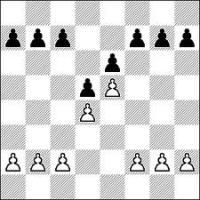
Symmetrical position with White to play. But here Black has finished fight for the center and space - he has equalized on both issues, with no difficulties on developing all his pieces at the optimal places. The position should be mark as equal.
Now let's see 3. e5. (Advance Variation of the French defense)
Even if 3. e5 is not the most popular choice, I will post a radical and daring state that this is the main position from which everyone should start to examine opening as the French defense. Occurred position is not important because of the move (3. e5), but because of the pawn structure. It is typical pawn position in the center for the French. Our main object will be to evaluate this structure, to find accurate plans for both sides - plans that should be valid in many other variations.
By focusing on the central pawn structure, how should we observe position on the board?
Let's start from the evaluation of space. There we can see that White controls more of the space, thanks to the e5-pawn. Also, there is a very passive Black's c8-bishop, "attacking" his own pawn-chain in the center. White has no such bad pieces, and no obvious weaknesses. Therefore, White has slight advantage. However, Black is on the move, and he will fight against his own weaknesses. The question is - how?
The main tasks should be developing minor pieces and fight for more space, primarily with reference to the structure in the center. Obviously, Black has to do something in the center, otherwise his pieces will be placed badly.
As we can see, White's advantage is "spacial"; how about doing something about it? How about choosing a plan which will strike against White's advantage? There are only two possibilities for Black to strike in the center. The question will be which White's pawn Black should undermine: e5 or d4?
And here we have simple thinking and solution: If we try to undermine e5-pawn by playing 3...f6, our threat is not very well considered. The reason is clear: after any of White's developing moves, and Black's capturing on e5, White will simply recapture with his d4-pawn. Thus White keeps important e5-pawn, and Black still has difficulties in developing his g8-Knight and c8-Bishop. The other possibility for White will be to support his e5-pawn with his own f-pawn, playing the move "pawn to f4" (not in this position), with an idea to recapture with his f-pawn. In that case White will keep both central pawns, which is strategically even better.
So, undermining the top of the pawn-chain is not very effective. The other option is to attack the base. In this case it is the d4-pawn, and it will be done with 3...c5.
And here we will underline one more guideline:
- To break up a pawn chain, (first) attack the base.
Before we start to think for White how to react, we should explain why Black shouldn't play other kind of moves. As we already said, if Black doesn't deal with White's pawns in the center, he will have problem in development very soon. For example, if Black played 3...Nc6, the line will go this way: 4. Nf3 Bd7 5. Be2 (there are better choices for White here, but this is more illustrative then, for example, 5. c3 with an idea to place light-square bishop on more active d3-square) and suddenly Black's pieces are buried with their own pawns and pieces. They want more air, and 3...c5 is doing that.
When I was a beginner, I liked moves like 3...f5, thinking that I will grab space if he doesn't capture (4. e:f6). This is an illusion, and strategical (huge) mistake. Move like 3...f5 is not solving the problem of space and white's domination in center. It only makes position harder for Black, because there is no potential undermining of White's e5-pawn, which is already annoying. Also, with pawn on f5, Black will have more difficult job to deal with his bad c8-bishop. Pay attention: all black central pawns are on the light squares, and his light-square Bishop is still on the board, behind his pawns. That is strategical suicide. For sure, White will not capture by en-passant, because he doesn't want to help Black developing his g8-Knight, nor to give him precious space for other pieces.
- Do not leave your Bishop to target your own pawns from behind.
OK, now we have logically justified 3...c5. What White should do?
If white wants to secure his central pawn-chain, he will support his base (d4-pawn) with 4. c3.
Now we will stop posting concrete moves. Instead, we will make another evaluation and try to find how both sides should consider their plans.
It's time to develop pieces, for both sides. But before making any move, both sides should make their strategy or plan of playing. White has clearer state and plan. His strategy is defined by the e5-pawn, which blocks not only the c8-Bishop, but also the g8-Knight, because it can't be placed on the natural f6-square. The pawn on the top of the chain is the main element in White position, and it tells White to play on the kingside. The reason is simple: Black has less space on that side, and his pieces cannot be placed well there.
Thus we have two more guidelines:
- During an attempt to make a plan, examine the pawn structure.
- Play on the side where you have more space.
On the other hand, White should think of how Black can try to release his pieces and get more space for himself, in order to prevent his attempts or to make other weaknesses in the opponent's position.
Next question will be how to place pieces according to the plan of playing on the kingside. First, g1-Knight will be developed on f3. It's his natural place, from which he can defend base of pawn-chain (d4), and also jump into the attack on g5, if it is needed. The f1-Bishop's best place is square d3, since diagonal b1-h7 targets directly position of Black's King, if he decides to castle. Of course, White should castle on the kingside. The other two minor pieces can wait to see how Black will play, especially the c1-Bishop, which can stay there for some time, because it is already shooting toward Black's kingside. Best place for the other Knight would be e2, where from that piece can jump to attacking post - f4-square; also, the Knight from e2 is strengthening d4 pawn-base. However, in most cases it is very difficult to obtain that good position with the b1-knight.
Now let's think how Black should play.
His pawn structure suggests him to play on the queen side, because his pieces have more freedom (space) on that side. Besides, Black should put some pressure on the base of White's pawn-chain (d4). It shouldn't be played so only with idea to capture the pawn, because White can easily defend, if he needs to. The true idea is more strategical then it is thought at first sight. It's about forcing White pieces to be placed more defensible than White would like, so that those pieces cannot attack Black's kingside. Also, when it comes to that situation, Black will strike with another pawn in the center - f6. Thus black will change the object of his pressure to the other White central pawn (e5), while White is not well prepared, because of defending the base (d4).
And, of course, one more idea shouldn't be forgotten because it is more logical then any other. It deals with (in "French" well-known) weakness called "bad c8-Bishop". Black should try to trade that bishop for any of White's minor pieces.
- Bishop that targets its own pawns, from behind, is bad, and should be traded off.
As it can be seen, Black's plan is more complicated, and it requires more positional understanding to play. This is the main reason why I do not suggest to any beginner player to choose the French defense as first opening choice against 1. e4.
